


 Cart
Cart
 sales@molnova.com



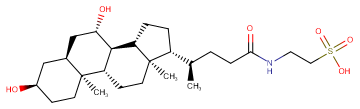
Tauroursodeoxycholic Acid
CAS No. 14605-22-2
Tauroursodeoxycholic Acid( 3α,7β-dihydroxy-5β-cholanoyl Taurine | TUDCA | UR-906 )
Catalog No. M11983 CAS No. 14605-22-2
Tauroursodeoxycholic acid is the more hydrophilic form of ursodeoxycholic acid, which is the more abundant naturally produced bile acid in humans.
Purity : >98% (HPLC)
 COA
Datasheet
HNMR
HPLC
MSDS
Handing Instructions
COA
Datasheet
HNMR
HPLC
MSDS
Handing Instructions
| Size | Price / USD | Stock | Quantity |
| 50MG | 45 | In Stock |


|
| 100MG | 57 | In Stock |
|
| 200MG | Get Quote | In Stock |
|
| 500MG | Get Quote | In Stock |
|
| 1G | Get Quote | In Stock |
|
Biological Information
-
Product NameTauroursodeoxycholic Acid
-
NoteResearch use only, not for human use.
-
Brief DescriptionTauroursodeoxycholic acid is the more hydrophilic form of ursodeoxycholic acid, which is the more abundant naturally produced bile acid in humans.
-
DescriptionTauroursodeoxycholic acid is the more hydrophilic form of ursodeoxycholic acid, which is the more abundant naturally produced bile acid in humans. Tauroursodeoxycholic acid, on the other hand, is produced abundantly in bears and has been used for centuries as a natural remedy in some Asian countries. Tauroursodeoxycholic acid is being investigated for use in several conditions such as Primary Biliary Cirrhosis (PBC), insulin resistance, amyloidosis, Cystic Fibrosis, Cholestasis, and Amyotrophic Lateral Sclerosis. The only completed clinical trial thus far is a phase III clinical trial comparing tauroursodeoxycholic acid and ursofalk in PBC adult patients, but as of June 2013 no results of this trial have been published.(In Vitro):Tauroursodeoxycholate (TUDCA) suppresses both viability and migration of vascular smooth muscle cells (VSMCs) through inhibition of ERK phosphorylation, by induction of mitogen-activated protein kinase phosphatase-1 (MKP-1) via PKCα. Tauroursodeoxycholate inhibits both the proliferation and migration of VSMCs via inhibition of ERK, through Ca2+-dependent PKCα translocation. Tauroursodeoxycholate prevents platelet-derived growth factor (PDGF) and vascular injury-induced MMP-9 expression. The knock-down of MKP-1 using specific si-RNA restores the reduced VSMC viability by Tauroursodeoxycholate (200 μM), which suggests that anti-proliferative effect of Tauroursodeoxycholate depended on the MKP-1 expression.(In Vivo):The effects of Tauroursodeoxycholate (TUDCA) on proliferation and apoptosis of VSMCs in vivo are examined using immunohistochemistry for proliferating cell nuclear antigen (PCNA) and the transferase dUTP nick-end labelling (TUNEL) assay. Tauroursodeoxycholate (10, 50, and 100 mg/kg) increases the caspase 3 activity of injured tissues in a dose-dependent manner, indicating that Tauroursodeoxycholate induces apoptosis of VSMCs in the neointima. Using the injured tissues, further examination and comparison of the phosphorylation level of ERK and MMP-9 expression is performed at 1 week after injury, compared with normal controls. Balloon injury increased both the phosphorylation of ERK and expression of MMP-9 in the tissues. Tauroursodeoxycholate (10, 50, and 100 mg/kg) inhibits phosphorylation of ERK and MMP-9 expression in a dose-dependent manner. Tauroursodeoxycholate (TUDCA) is a hydrophilic bile acid. Tauroursodeoxycholate as a cytoprotective agent improves liver function and can prevent hepatocellular carcinoma by reducing ER stress and apoptosis. Tauroursodeoxycholate significantly reduces expression of apoptosis molecules, such as caspase-3, caspase-12, C/EBP homologous protein, c-Jun N-terminal kinase (JNK), activating transcription factor 4 (ATF4), X-box binding protein (XBP), and eukaryotic initiation factor 2α (eIF2α) in Ang II induced ApoE-/- mice (p<0.05). Tauroursodeoxycholate reduces Angiotensin (Ang) II induced abdominal aortic aneurysm (AAA) formation in ApoE-/- mice. Tauroursodeoxycholate is used at a dose of 0.5 g/kg/day in treating Ang II induced ApoE-/- mice (ER stress inhibitor group). Systolic blood pressure (141.3±5.6 mmHg vs 145.9±8.9 mmHg; p>0.05) and total cholesterol levels (663.6±88.7 mg/dL vs 655.7±65.4 mg/dL; p>0 .05) do not differ between the AAA model group and Tauroursodeoxycholate group. In addition, maximum aortic diameter is significantly smaller in those in Tauroursodeoxycholate group compared with those in the AAA model group (0.95±0.03 mm vs 1.79±0.04 mm; p<0.05). AAA lesion areas are also smaller in those in Tauroursodeoxycholate group than in those in the AAA model group (0.37±0.03 mm2 vs 1.51±0.06 mm2; p<0.05).
-
In Vitro——
-
In Vivo——
-
Synonyms3α,7β-dihydroxy-5β-cholanoyl Taurine | TUDCA | UR-906
-
PathwayMetabolic Enzyme/Protease
-
TargetP450
-
RecptorCYP3A
-
Research Area——
-
Indication——
Chemical Information
-
CAS Number14605-22-2
-
Formula Weight499.7
-
Molecular FormulaC26H45NO6S
-
Purity>98% (HPLC)
-
SolubilityDMSO: 10 mM
-
SMILESC[C@H](CCC(=O)NCCS(=O)(=O)O)[C@H]1CC[C@@H]2[C@@]1(CC[C@H]3[C@H]2[C@H](C[C@H]4[C@@]3(CC[C@H](C4)O)C)O)C
-
Chemical Name——
Shipping & Storage Information
-
Storage(-20℃)
-
ShippingWith Ice Pack
-
Stability≥ 2 years
Reference
1.Paolini M, et al. Hepatology. 1999 Sep;30(3):730-9.
molnova catalog



related products
-
Epimedin A1
Epimedin A1(Hexandraside F) is a flavonoid extracted from Herba Epimedii which is one of commonly used Chinese medicines.
-
1-Aminobenzotriazole
1-Aminobenzotriazole (ABT) is a non-specific cytochrome P450 (CYP) inhibitor.
-
Antihistamine-1
Antihistamine-1 is an H1-antihistamine (Ki: 6.9 nM) with acceptable blood-brain barrier penetration and also an inhibitor of CYP2D6 and hERG channel (IC50s: 5.4 and 0.8 μM).
